
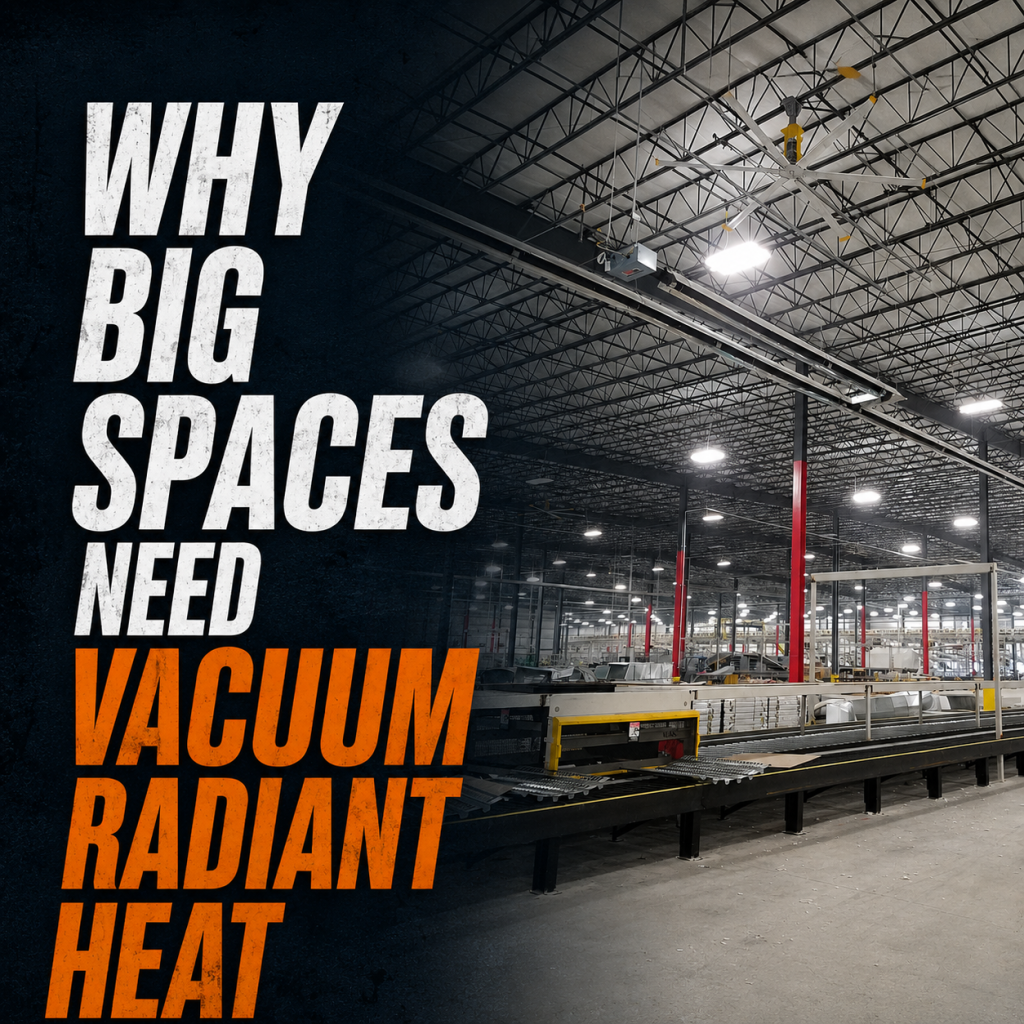
Why Big Spaces Need Vacuum Radiant Heat
Introduction
A Vacuum Radiant System is one of the most effective ways to heat a large commercial or industrial space when you need even heat, fewer roof or wall penetrations, and high efficiency. In a recent startup on an HLV engineered system in Lowell, Massachusetts, the setup showed exactly why this approach works so well for warehouses, distribution centers, and other big buildings.
These systems are built for scale. They are factory engineered, designed to deliver serious output, and configured to heat large footprints more evenly than many conventional approaches. When the goal is reliable comfort across a massive building, a Vacuum Radiant System deserves a close look.
What Makes a Vacuum Radiant System Different?
The biggest difference is how heat moves through the system.
With a typical radiant tube heater, the burner pushes the flame and hot gases through the tube, this is commonly known as a positive pressure system. A Vacuum Radiant System works the other way around. Instead of pushing, it pulls. A vacuum pump at the end of the run draws the air and combustion products through the tubing, creating a negative pressure system.
That change in flow makes a real difference. Pulling heat through the tubes helps create a much more uniform temperature profile across the system. In practical terms, that means more even heating throughout the building instead of concentrated hot and cool zones.
Designed for Large-Scale Heating
An HLV engineered Vacuum Radiant System is not a small, single-heater solution. It is designed specifically for larger spaces and can produce up to 750,000 BTUs per system.
Another major advantage is system layout. You can connect up to six burner boxes on one system. That gives designers and contractors a lot of flexibility when heating large open areas.
For building owners and installers, this creates several important benefits:
- High total capacity for large commercial and industrial buildings
- Multiple burner boxes on one system for broad heat coverage
- Fewer building penetrations because the exhaust can be combined
- Cleaner installation planning for complicated rooflines or wall layouts
Why Fewer Penetrations Matter
One of the most practical features of a Vacuum Radiant System is that multiple burner boxes can be routed to a single exhaust penetration. Instead of creating separate exhaust terminations for every heater, the system can bring those runs together and vent through one location, either through the roof or a sidewall.
That matters more than people sometimes realize.
Every penetration in a building envelope is something that needs to be planned, sealed, flashed, and maintained. Reducing the number of penetrations can simplify installation and help avoid unnecessary complications later. On large buildings, that can be a major win.
How The System is Laid Out
In the Lowell installation, the system had four burner boxes, though only part of the layout was highlighted during the startup. One burner box included a 45 degree jog, showing that the system can be routed to accommodate real-world building conditions instead of requiring a perfectly straight path everywhere.
As the tubing runs across the building, the individual branches come together near the end of the system, where the vacuum pump is located. That pump is the heart of the operating concept. It is what creates the negative pressure that draws everything through the tubes.
This is why the heat profile is so even. The system is not relying on each burner to simply force combustion products down the line. The vacuum action helps maintain balanced flow and consistent performance across the connected runs.
Even Heat is One of the Biggest Advantages
Large buildings are notoriously difficult to heat well. You can have one area that feels warm and another area that feels underheated, especially in spaces with high ceilings, open floor plans, loading doors, or constant traffic.
A Vacuum Radiant System addresses that problem by distributing heat far more evenly across the building. That is one of the standout benefits of this style of radiant heating.
For warehouses and industrial facilities, even heat matters because it affects more than comfort. It can influence:
- Worker comfort across the floor
- Temperature consistency in operational zones
- Performance near doors and traffic lanes
- How effectively the whole building uses energy
When the heating pattern is balanced, the entire space tends to perform better.
Efficiency and Condensing Performance
Another strength of the HLV engineered Vacuum Radiant System is its potential to operate in condensing mode. In simple terms, condensing means the system is recovering as much usable heat as possible before it leaves the building.
That is about as good as it gets from an efficiency standpoint. When a heating system condenses, it extracts additional heat from the exhaust stream rather than letting that energy go to waste. For facilities focused on operating cost and energy performance, that can be a major selling point.
In large buildings, efficiency gains add up quickly. A system that captures more of the generated heat and delivers it into the occupied space can make a meaningful difference over time.
What Happens During Startup
Installing a Vacuum Radiant System is only part of the job. Proper startup is what ensures the system operates the way it was designed to.
During startup, the focus is on fine-tuning and verification. That includes checking the burner boxes, measuring pressures, and balancing the system so it performs at its best.
A professional startup typically involves:
- Confirming that pressure settings are correct
- Checking atmospheric conditions at the burner boxes
- Adjusting dampers where needed
- Balancing the full system for optimal operation
Those steps matter because an engineered heating system needs to be dialed in, not just turned on. A well-balanced Vacuum Radiant System will deliver better efficiency, better heat distribution, and more reliable long-term performance.
Where This Type of System Makes Sense
This is not just a niche option for one type of building. A Vacuum Radiant System can be used in some of the largest facilities out there.
These systems are well suited for:
- Warehouses
- Distribution centers
- Large industrial buildings
- Logistics and shipping facilities
- Expansive commercial spaces with high ceilings
They have already been used in major facilities such as Amazon and FedEx distribution centers, which tells you a lot about the scale they can handle. If a heating solution can serve buildings of that size, it is clearly built for serious demand.
Why Contractors and Building Owners Should Pay Attention
If the conversation around radiant heat usually stops at single tube heaters, it is worth thinking bigger. A Vacuum Radiant System opens the door to heating very large spaces with a more engineered, more centralized approach.
The appeal comes down to a few core advantages:
- Capacity that fits large buildings
- Even heat distribution across the space
- Reduced penetrations for cleaner venting design
- High efficiency potential, including condensing operation
- Professional balancing and startup for optimized performance
For facilities that need dependable heat without overcomplicating the building envelope, that combination is hard to ignore.
The Bottom Line on a Vacuum Radiant System
A well-designed Vacuum Radiant System is a powerful option for heating large buildings. It delivers uniform radiant heat, supports multiple burner boxes on a single engineered system, reduces exhaust penetrations, and can reach very high levels of efficiency.
When a system is properly installed and correctly started up, it becomes a smart long-term solution for warehouses, distribution centers, and other large facilities that need serious heating performance.
If the goal is to heat a big space effectively and efficiently, a Vacuum Radiant System is absolutely worth considering.
Need Help Heating a Large Commercial or Industrial Building?
If you’re trying to heat a warehouse, distribution center, manufacturing space, or other large facility, the right system layout matters.
At Great Lakes Radiant, we help walk through large-scale radiant heating applications every day. From evaluating building size and heat requirements to reviewing venting, burner placement, roof or wall penetrations, and system layout, we’ll help you determine whether a Vacuum Radiant System makes sense for your space.
Whether you’re dealing with uneven heat, too many vent penetrations, layout challenges, or planning a new large-building heating project, we’ll help you get it right the first time.
Send us photos, dimensions, construction documents, or fill out our Project Details form — we’re here to help.
📞 (888) 501-0252
📧 sales@glradiant.com
🌐 www.glradiant.com