
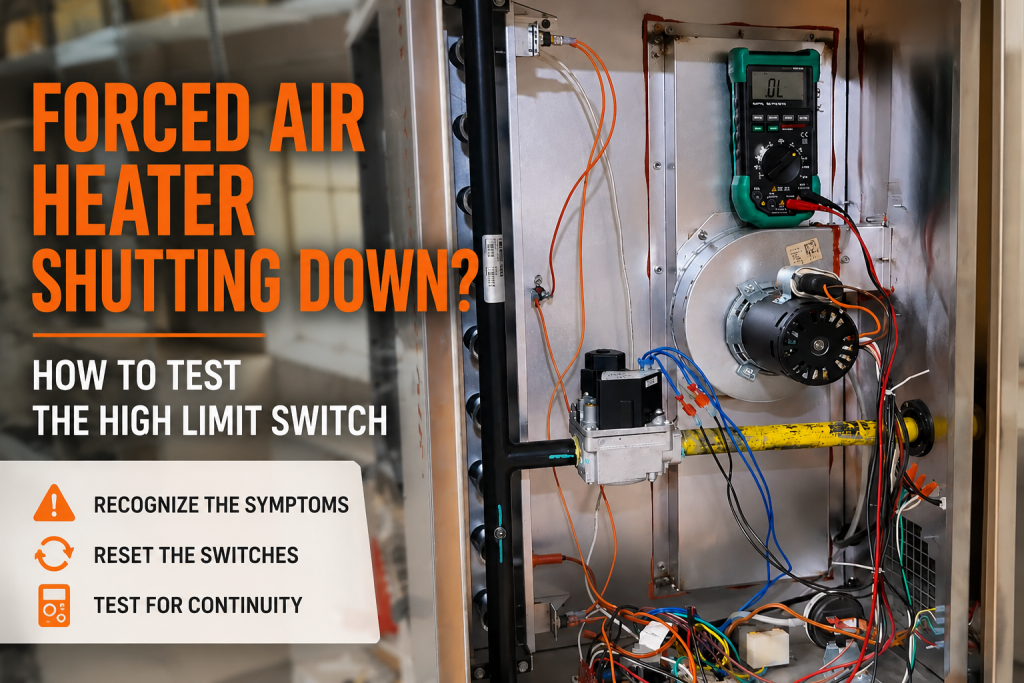
Forced Air Heater Shutting Down? How to Test the High Limit Switch
Introduction
A forced air unit heater that shuts down unexpectedly may be reacting to a high limit or flame rollout switch issue. One of the clearest signs is the fan sequence: when there is a call for heat, the inducer fan and the room circulating fan start at the same time.
Under normal operation, the inducer fan starts first, ignition occurs, and the room circulating fan should come on roughly 30 seconds later. When both fans start together, the heater is signaling that a limit switch related fault needs attention.
Key Takeaways
- Simultaneous inducer and circulating fan startup can indicate a limit switch related fault.
- Three, six, or seven control board flashes can point to high limit or rollout switch issues.
- Reset rollout switches manually, but allow the high limit switch to reset after cooling.
- A continuity failure across any safety switch confirms that switch needs replacement.
Recognize a High Limit or Flame Rollout Switch Fault
Start with the heater’s sequence of operation. A simultaneous startup of the inducer fan and room circulating fan during a heat call is not normal. It is an indicator that the heater may be in a limit switch related condition.
The control board can provide another useful clue. A three, six, or seven flash code can indicate a problem related to the high limit switch or flame rollout switches. Check the unit’s service information to confirm what the diagnostic flash code means for that specific model.
These safeties are there to protect the heater. Before treating a switch as the problem, take the shutdown seriously and look for the condition that caused it to trip.
Common Causes of Limit Switch Problems
A high limit or rollout switch may trip because the heater is overheating, airflow is restricted, combustion air is blocked, or the fuel setup is incorrect. Common causes include:
- Excessive manifold pressure
- A blocked intake or exhaust
- A blocked fan guard
- Fully closed louvers
- Propane being supplied to a natural gas orifice
Each of these conditions can affect how the unit burns fuel, moves air, or expels heat. Correcting the underlying cause matters just as much as getting the heater to restart. If the source of the fault remains, the heater can continue to shut down.
Reset the High Limit and Flame Rollout Switches
Always follow the heater manufacturer’s service instructions and proper safety procedures before accessing heating equipment.
The two types of safety switches reset differently:
- High limit switch: This switch resets automatically after the heater has cooled down.
- Flame rollout switches: These switches can be reset using the small button located between the two terminals on each switch.
After the heater has cooled and the rollout switches have been reset, restore operation according to the unit’s service procedure and see whether the fault is resolved. A successful reset can get the unit running again, but it does not eliminate the need to investigate the cause of the trip.
How to Test a High Limit or Rollout Switch With a Multimeter
If resetting the switches does not resolve the issue, a failed switch becomes more likely. The next step is to check each high limit and flame rollout switch for continuity.
Using a multimeter, measure continuity across the two terminals on each switch. Perform the check in accordance with the heater’s service instructions and proper electrical safety practices.
If any one of the switches fails the continuity test, that confirms the switch is bad and needs to be replaced.
Do Not Ignore Repeated Heater Shutdowns
A forced air heater that repeatedly trips a high limit or flame rollout switch is telling you that something needs attention. Resetting a switch may be part of troubleshooting, but it should not become the ongoing fix.
Check for airflow restrictions, intake and exhaust obstructions, closed louvers, manifold pressure issues, and fuel-orifice mismatches. Then verify continuity on the high limit and rollout switches if the fault remains. This simple process helps narrow the problem down to either a tripped safety caused by an operating condition or a switch that has failed and requires replacement.
Need Help Troubleshooting a Forced Air Heater That Keeps Shutting Down?
A forced air heater that repeatedly shuts down can be frustrating to diagnose. If you’ve checked the basics and still can’t determine what’s causing the problem, Great Lakes Radiant can help.
We provide heating equipment, replacement parts, and technical support to help you troubleshoot and keep your heating system operating properly.
📞 (888) 501-0252
📧 sales@glradiant.com
🌐 www.glradiant.com