
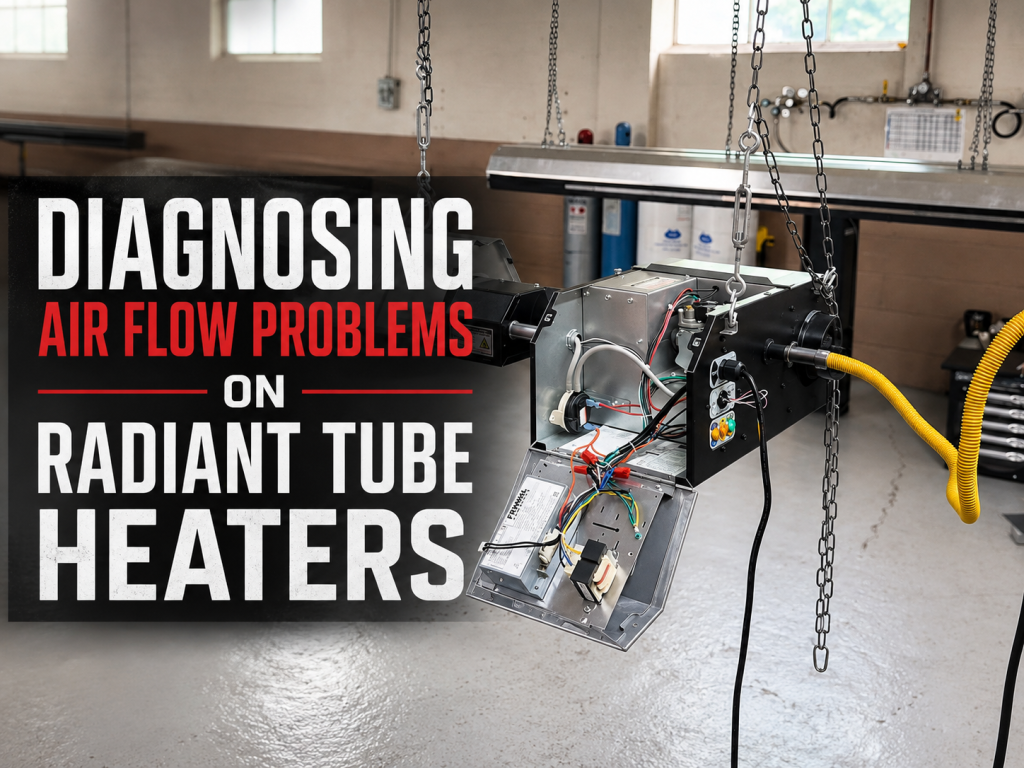
Diagnosing Air Flow Problems on Radiant Tube Heaters
Introduction
If a radiant tube heater fails to ignite or shuts down within the first eight seconds of operation, an airflow-related fault may be preventing normal combustion. These problems can be frustrating because the heater may begin its ignition sequence, appear close to lighting, and then shut itself down.
The key is to recognize the fault pattern, identify what the diagnostic lights are telling you, and work through the most common airflow checks before replacing components.
Recognize the Symptoms of an Airflow Issue
An airflow-related issue commonly shows up in one of two ways:
- The heater fails during ignition.
- The heater lights briefly but drops out before eight seconds have passed.
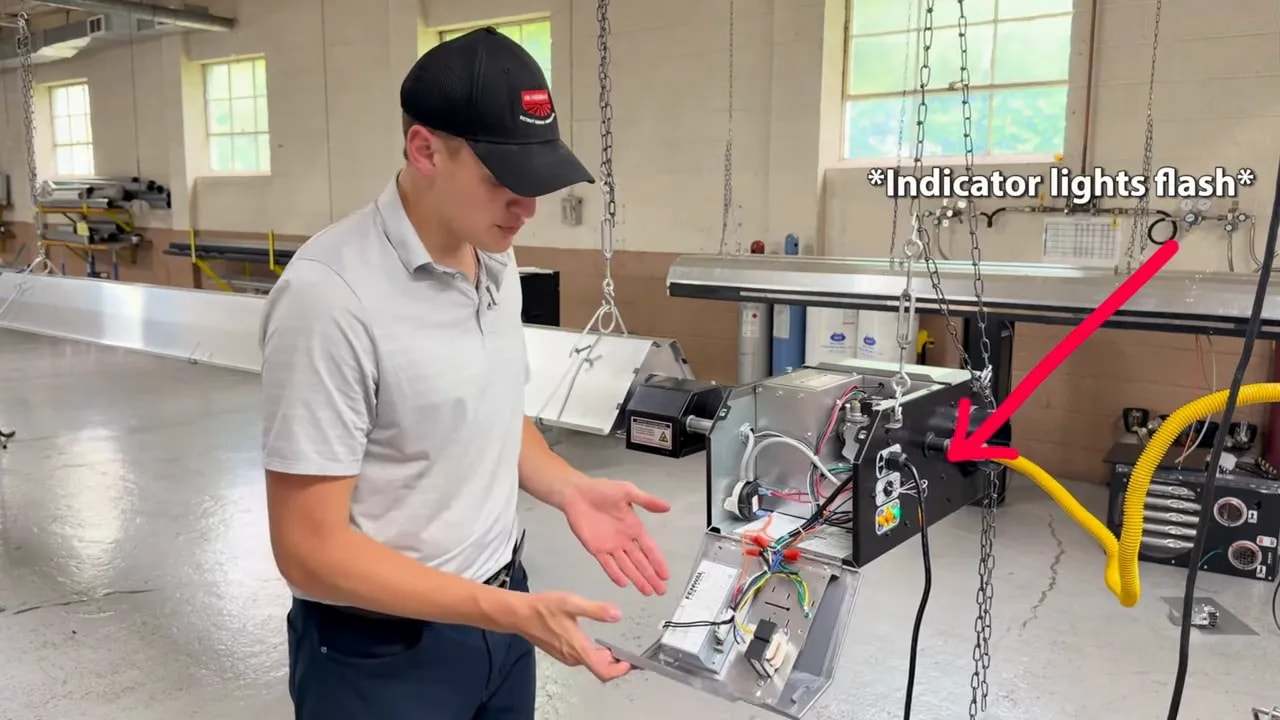
During an unsuccessful ignition attempt, the heater’s indicator lights may flash. Depending on the heater model, the ignition can also be inspected through the sight glass on the opposite side of the starter tube.
When the heater does not establish proper operation, it will make two additional ignition attempts. If those attempts also fail, the unit enters a soft lockout. This is the heater’s way of stopping repeated ignition attempts after it detects a condition that needs to be corrected.
Check the Circuit Board Diagnostic Light
On radiant tube heater models equipped with a circuit board diagnostic light, an airflow-related fault is identified by a two-flash code.
That code provides a useful starting point, but it is not a reason to immediately replace a component. A pressure switch may be involved, but the heater’s intake, exhaust, venting configuration, blower, baffles, and manifold pressure all need to be checked first.
Common Causes of Radiant Heater Airflow Faults
Airflow faults can originate from several places in the heater and venting system. Work through these possible causes methodically.
1. Blocked Intake or Exhaust
Inspect the combustion air intake and exhaust path for restrictions. A blockage can keep the heater from moving the air required for proper ignition and operation. Any obstruction in either path can affect the pressure conditions the heater needs to run.
2. Incorrect Baffle Quantity or Placement
Baffles are part of the heater’s designed airflow path. If the quantity is wrong or the baffles are installed in the wrong locations, the system may not operate as intended. Confirm that the heater has the correct baffle arrangement for its application.
3. Improper Venting Lengths
Venting must be configured within the heater’s required limits. Improper vent lengths can create excessive resistance or otherwise disrupt the airflow needed for reliable ignition. Verify the installed venting lengths against the requirements for the specific heater model.
4. Manifold Pressure That Is Too High
Excessively high manifold pressure can also contribute to airflow-related operating problems. Confirm that manifold pressure is set correctly before assuming the fault is caused by an electrical part.
5. A Bad Blower
The blower is responsible for moving air through the heater’s combustion and venting system. If it is not operating properly, the heater may fail at ignition or shut down shortly after lighting. A blower issue should be considered as part of the overall airflow diagnosis.
When to Suspect the Pressure Switch
After checking the intake, exhaust, baffle arrangement, venting lengths, manifold pressure, and blower, the remaining issue may be a failed pressure switch.
The pressure switch is part of the heater’s safety system. It helps verify that the correct airflow conditions are present before and during operation. If the rest of the airflow system checks out and the heater continues to show the same fault pattern, the pressure switch becomes the next likely component to investigate.
A Practical Airflow Troubleshooting Sequence
Use this order to keep the diagnosis focused:
- Confirm the symptom: failed ignition or shutdown before eight seconds.
- Observe the indicator lights during the ignition attempt.
- Inspect ignition through the starter tube sight glass when applicable.
- Note whether the heater completes three attempts and enters soft lockout.
- Check for a two-flash diagnostic code on models with a board-mounted diagnostic light.
- Inspect the intake and exhaust for blockages.
- Verify baffle quantity and placement.
- Confirm venting lengths are correct.
- Check that manifold pressure is not too high.
- Evaluate blower operation.
- If these checks pass, investigate the pressure switch.
Keep the Diagnosis Systematic
A two-flash diagnostic code and repeated ignition failure point you toward an airflow-related issue, but the code is only the beginning of the process. Start with the straightforward mechanical checks, verify the installation details, and then move to components such as the blower and pressure switch.
That systematic approach helps isolate the actual cause of a radiant tube heater ignition fault and avoids replacing parts before the underlying airflow problem has been addressed.
Need Help Troubleshooting a Radiant Tube Heater Airflow Fault?
If your radiant tube heater fails during ignition, shuts down within the first few seconds, or shows an airflow-related diagnostic code, the right troubleshooting sequence matters.
At Great Lakes Radiant, we help walk through real-world radiant tube heater troubleshooting every day. From reviewing two-flash fault codes and pressure switch concerns to checking intake and exhaust blockages, baffle placement, venting lengths, blower operation, manifold pressure, and overall system setup, we’ll help you narrow down the issue without jumping straight to unnecessary part replacement.
Whether you’re dealing with repeated ignition attempts, soft lockout, a suspected airflow problem, or a heater that starts and drops out before it can stay lit, we’ll help you get it right the first time.
Send us photos, heater model information, fault codes, venting details, pressure readings, or fill out our Project Details form, we’re here to help.
📞 (888) 501-0252
📧 sales@glradiant.com
🌐 www.glradiant.com