
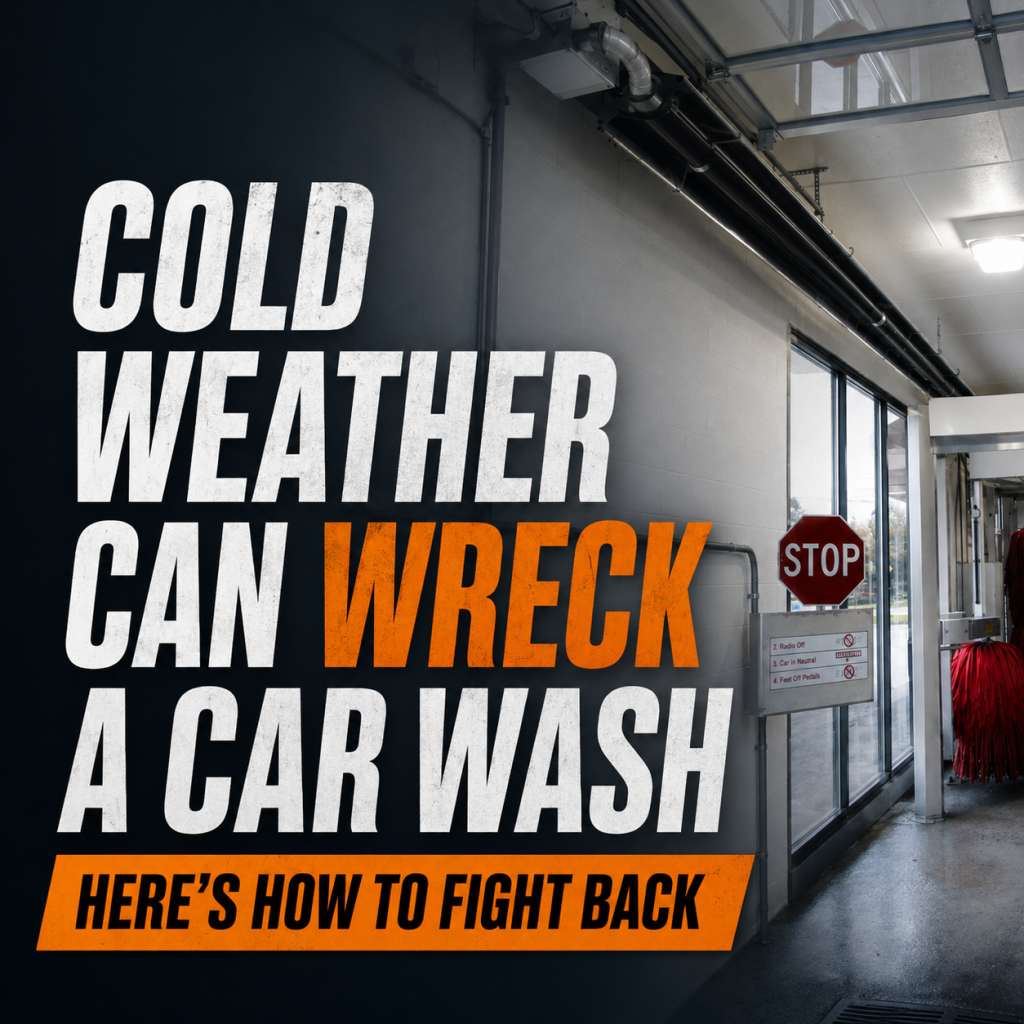
Cold Weather Can Wreck a Car Wash: Here’s How to Fight Back
Introduction
Heating a car wash is not like heating a typical commercial building. The priorities are completely different.
You are not focused primarily on occupant comfort. You are focused on:
- Preventing freeze-ups
- Protecting expensive equipment
- Reducing heater failures
- Keeping operating costs under control
- Surviving harsh wet and chemical-heavy conditions
Depending on where you are heating inside the car wash, the strategy changes.
The heating needs of the tunnel itself are very different from the needs of the equipment room. One space deals with constant airflow, moisture, and traffic. The other is focused almost entirely on freeze protection and reliability during shutdowns or power outages.
Choosing the wrong heating approach can lead to frozen pipes, damaged wash equipment, repeated heater replacements, and unnecessary energy costs.
The good news is there are proven solutions that work extremely well when they are designed correctly.
Why Car Wash Heating Is Different
Car washes create one of the harshest environments possible for heating equipment.
You are dealing with:
- Constant moisture
- Chemicals in the air
- Frequent door openings
- Wind and air movement
- Freeze-risk conditions
- Tight equipment clearances
- High operating demands
That means a heating system that works perfectly in a warehouse or shop may fail quickly inside a car wash.
A successful car wash heating system has to balance freeze protection, durability, efficiency, proper material selection, and real-world operating conditions.
And that starts with understanding the two main areas separately:
- The car wash tunnel
- The equipment room
Heating the Car Wash Tunnel
The tunnel is where most of the freeze protection battle happens.
You are trying to protect:
- Brushes
- Floors
- Wash components
- Piping
- Equipment surfaces
At the same time, you are fighting constant air movement from vehicles entering and exiting the wash. Heated air escapes fast.
That is why tunnel heating requires more thought than simply installing “a heater.”
The Two Main Tunnel Heating Options
For tunnel heating, there are typically two starting points:
- Forced air heating
- Radiant heating
Both can work, but they behave very differently.
When Forced Air Makes Sense
Forced air can be the right solution when the tunnel is too crowded for radiant heaters.
Some car wash tunnels have:
- Tight ceiling spaces
- Dense equipment layouts
- Brushes and hoses close to the ceiling
- Clearance limitations
Radiant tube heaters require specific clearances to combustibles, especially below the heater. In some tunnels, there simply is not enough room to install radiant safely.
In those cases, a compact unit heater mounted high in a corner may be the only practical option.
That is why tunnel heating should never be treated as a one-size-fits-all HVAC decision. The layout drives the answer.
Why Radiant Heat Is Usually Preferred
When the tunnel layout allows for it, radiant heat is usually the better solution.
Here is why:
Forced air heats the air itself. But in a car wash tunnel, warm air constantly escapes every time doors open or wind pushes through the building.
Radiant heat works differently.
Instead of only heating air, radiant systems heat:
- Concrete floors
- Metal surfaces
- Wash equipment
- Structural mass inside the tunnel
Those surfaces then continue re-radiating heat back into the space. That means the tunnel retains heat more effectively even during heavy airflow conditions.
For freeze protection, that is a huge advantage.
Not All Car Wash Heaters Are Built for Harsh Environments
This is one of the biggest mistakes made in car wash heating projects.
Some heaters are marketed as “harsh environment” products, but that does not necessarily mean they are designed to survive long term inside a wet, chemical-heavy tunnel.
For car wash applications, material selection matters.
Look for:
- Stainless steel burner boxes
- Stainless steel tubes
- Stainless steel reflectors
- Stainless steel hanging hardware
Moisture and chemicals attack weak points quickly. If only part of the heater is corrosion-resistant, the remaining components often become the failure point.
Fresh Air Piping Is Critical
Whether you choose forced air or radiant heat, combustion air should come from outside the tunnel.
That means piping fresh air directly to the heater from:
- The roof
- The wall
Typical intake materials include:
- PVC
- Galvanized vent pipe
This prevents the heater from pulling contaminated, chemical-laden air through the burner assembly.
It is a simple design decision that can dramatically improve heater longevity.
Heating the Equipment Room
The equipment room is a completely different challenge.
Most equipment rooms already generate heat during operation because the equipment itself runs warm.
The real concern comes when:
- Equipment shuts down
- The wash is idle
- Power is lost during freezing weather
That is when pipes, water lines, and wash components become vulnerable to freezing.
And that is where equipment room heating becomes extremely important.
Equipment Room Heating Options
There are generally three practical approaches:
- Small gas-fired unit heaters
- Electric radiant heaters
- High-intensity ceramic heaters with millivolt controls
Each has advantages depending on the room conditions.
Option 1: Small Gas-Fired Unit Heaters
A common solution is a small gas-fired unit heater, usually around 30,000 BTUs.
A typical setup includes:
- Natural gas or propane
- Venting to the exterior
- Control by a traditional thermostat
- A freeze protection setpoint around 35–40°F
This works well in many applications and is often the simplest approach.
However, in some equipment rooms, even the smallest gas unit heater may provide more heat than the space actually needs.
Option 2: Electric Radiant Heat
Electric radiant heaters can be a strong option when:
- Lower heat output is needed
- Forced air is not ideal
- Electrical service is available
Electric radiant systems are available in voltages ranging from 120V to 480V, giving flexibility depending on the building’s electrical setup.
The right choice depends heavily on the room layout and operating conditions.
Option 3: DR Series High-Intensity Ceramic Heater
For many equipment rooms, the standout option is a DR Series high-intensity ceramic heater with a millivolt configuration.
The biggest advantage?
It can continue operating during a power outage.
Why That Matters
With the millivolt setup:
- No 120V power is required
- No 24V control power is required
- The heater can operate from a wired thermostat
That means if electrical power fails during freezing conditions, the heater can still protect the room and prevent catastrophic freeze damage.
For car washes, that can be incredibly valuable.
Important Ventilation Consideration
The DR Series heater discussed above exhausts into the room.
That means ventilation planning is critical.
Typical approaches include:
- A small wall louver
- An exhaust fan that operates whenever the heater runs
This allows exhaust gases to leave the space safely while still preserving the freeze-protection benefits of the heater design.
How to Choose the Right Car Wash Heating Solution
Every car wash is different.
The best heating solution depends on:
- Tunnel dimensions
- Equipment layout
- Ceiling clearances
- Available utilities
- Ventilation conditions
- Freeze-risk concerns
- Existing airflow conditions
That is why proper heating design should never rely on guesswork.
A good design process should include:
- Pictures of the tunnel and equipment room
- Room dimensions
- Construction documents
- Utility information
- Dimensional layouts
- Proper BTU calculations
- Honest evaluation of what will and will not work
A Simple Framework for Evaluating Your Options
If you are comparing heating systems for a car wash, ask these questions:
- Are you heating the tunnel, the equipment room, or both?
Each area has different challenges and may require a different heating strategy. - Is the main goal freeze protection?
In most car wash applications, the answer is yes. That means reliability at low temperatures matters more than comfort heating. - Does the tunnel have enough clearance for radiant heat?
If not, forced air may be the more practical option. - Is the heater built for moisture and chemicals?
Stainless steel construction is critical in harsh car wash environments. - Where is combustion air coming from?
Pulling chemical-heavy air from inside the wash can shorten equipment life. - What happens during a power outage?
This is especially important for equipment rooms where freeze damage can happen quickly.
The Bottom Line
Car wash heating is really about one thing:
Reliable freeze protection in a harsh environment.
For tunnels, radiant heat is usually the preferred solution because it heats surfaces and equipment instead of relying entirely on warm air that quickly escapes.
But the tunnel must support proper clearances safely.
For equipment rooms, reliability during power outages can become the deciding factor, which is why millivolt ceramic heaters are often so attractive.
No matter which approach you choose, long-term success comes down to:
- Proper sizing
- Correct layout evaluation
- Stainless steel materials
- Outside combustion air
- Thoughtful freeze-protection planning
Get those pieces right, and you dramatically improve your chances of protecting the wash, reducing heater failures, and avoiding expensive cold-weather shutdowns.
Need Help Choosing the Right Heating Solution for Your Car Wash?
If you’re trying to protect a car wash tunnel, equipment room, piping, or wash components from freezing, the right heater choice matters.
At Great Lakes Radiant, we help walk through real-world car wash heating applications every day. From comparing radiant heat vs. forced air to reviewing equipment room freeze protection, clearances, ventilation, utilities, and layout, we’ll help you figure out what solution makes the most sense for your space.
Whether you’re dealing with repeated heater failures, planning a new car wash, upgrading an existing tunnel, or trying to protect equipment during cold weather, we’ll help you get it right the first time.
Send us photos, dimensions, construction documents, or fill out our Project Details form — we’re here to help.
📞 (888) 501-0252
📧 sales@glradiant.com
🌐 www.glradiant.com
We’ll be at The Car Wash Show in Nashville!
Great Lakes Radiant will be at The Car Wash Show, May 11–13, 2026.
Stop by and say hi at Booth #NCP608, and here’s the fun part:
Tell us the secret code (NO FREEZE) at the booth and you’ll unlock a special show discount.
Come find us in Nashville, we’d love to talk car wash heating, freeze protection, and equipment room