
Highly Polished Reflectors WINS for Radiant Tube Heaters
Introduction
There are a lot of details that matter when you are choosing a radiant tube heater, but one of the most overlooked is the reflector. It might sound like a small component, but reflector quality directly affects how much heat actually makes it out into the space where you need it.
If you are shopping for Re-Verber-Ray, Detroit Radiant Products, or any radiant tube heating system, here is the key question to ask: Do you have a highly polished reflector or a mill finish reflector? That one choice can dramatically change performance.
Why the reflector matters in radiant heating
Radiant tube heaters work by emitting radiant energy downward (and outward) toward the floor, people, and nearby surfaces. The reflector’s job is to send that radiant energy back out instead of letting it get lost as absorption or scattered inefficiency.
In simple terms: the reflector is not just “backing” the tube. It is actively shaping how efficiently radiant energy reaches the ground.
Mill finish reflectors: decent, but significantly less efficient
Mill finish reflectors are reflecting only about 35% to 60% of the radiant beams coming off the heater.
That means a large portion of the energy is not being redirected effectively. The radiant beams essentially bounce around, but not in a controlled way that returns the energy toward where it will do the most good.
What “mill finish” looks like in real life
A quick way to visualize the difference is how the surface reflects. With a mill finish, you typically cannot see a clear reflection. It does not behave like a mirror.
Highly polished reflectors: much higher reflectivity and better redirection
Highly polished reflectors can reflect about 60% to 90% of the radiant beams.
That is a big deal. The difference between 35% to 60% and 60% to 90% can be close to double efficiency depending on conditions and the specific reflector surface quality.
The “mirror finish” test
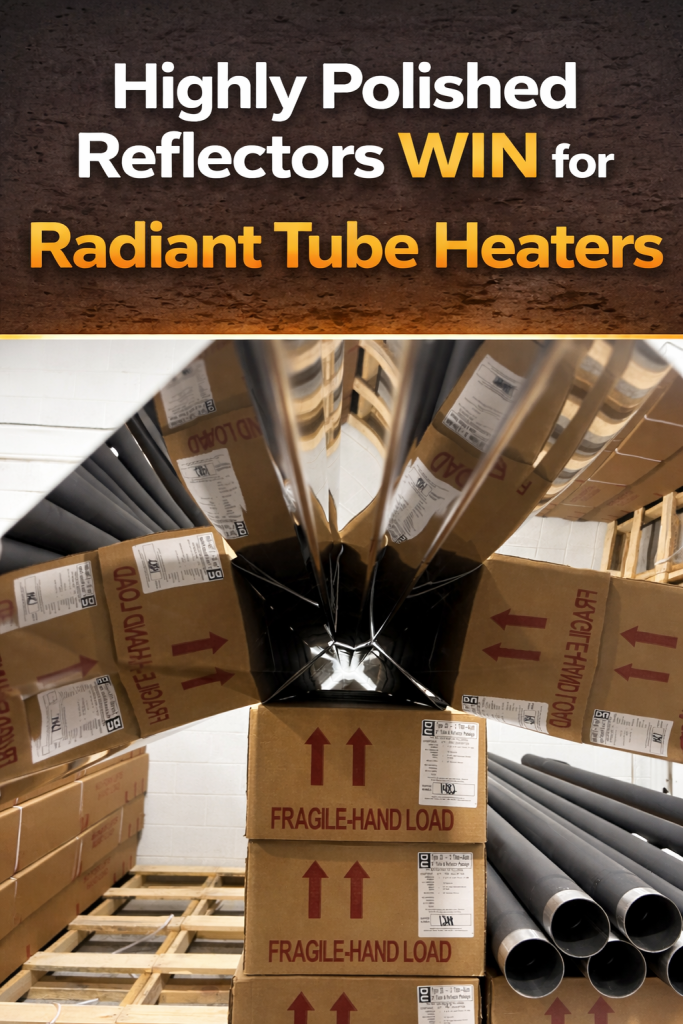
Highly polished reflectors should have a near mirror finish, especially on the bottom surface. If you look closely, you can often see your face in the reflection.
That mirror-like quality matters because it helps the radiant energy bounce back in a more effective path toward the ground instead of being absorbed by the reflector material.
Ask manufacturers the right question before you buy
If you are in the market for a tube heater and you are comparing models, do not just compare output numbers. Ask about reflector finish and reflectivity.
Use this checklist when speaking with manufacturers or distributors:
- Is the reflector highly polished or mill finish?
- What reflectivity range is expected? (Mill finish: ~35% to 60%; highly polished: ~60% to 90%)
- Does the reflector have a mirror finish on the bottom?
- How is the radiant energy redirected toward the floor?
What this means for performance: more usable heat
Reflectivity is essentially about how much of the heater’s radiant output you actually get to use. A highly polished reflector is designed to maximize the return of radiant energy toward the space, rather than allowing it to scatter unpredictably or get absorbed.
So when you select a radiant tube heater with highly polished reflectors, you are not just buying better optics. You are improving the efficiency of how the unit turns radiant energy into comfort.
Where Re-Verber-Ray and Detroit Radiant products fit in
Re-Verber-Ray by Detroit Radiant Products uses highly polished reflectors on just about every unit produced out of Detroit, Michigan.
That focus on reflector finish is part of why radiant systems from Detroit Radiant are often able to deliver strong comfort and consistent performance for both indoor and outdoor applications.
Outdoor comfort example: a patio heater that feels like a warm shower
Reflector quality is easy to understand indoors, but it is also obvious outdoors when conditions are tough. A four-foot wide patio heater from the DSC series can feel incredible on a cold day, providing that “warm shower” effect directly where it matters most.
That comfort is exactly what efficient radiant redirection helps accomplish. When the reflector is doing its job well, more radiant energy reaches people and surfaces instead of being wasted.
Bottom line
If you want the most efficient radiant tube heater, pay attention to the reflector finish.
- Mill finish reflectors: ~35% to 60% reflectivity
- Highly polished reflectors: ~60% to 90% reflectivity
And remember the quick practical indicator: a highly polished reflector should look like a mirror. You should be able to see a reflection clearly, not just random bounced glare.
When comfort and efficiency are the goal, highly polished reflectors are the clear winner.
More about radiant tube heater performance
When you’re evaluating radiant tube heaters, it helps to look beyond reflector finish and understand how the system is designed for efficient heat transfer. For a deeper overview of radiant tube heater basics, see radiant tube heater FAQ.
If you’re comparing different product configurations and want to understand how radiant heat works in real applications, this guide to infrared vs radiant heating can help you frame the tradeoffs.
Finally, if you’re planning an installation and want practical guidance to avoid performance issues, review common installation mistakes before you buy or set the units.
Need Help Choosing the Right Radiant Tube Heater?
Our team at Great Lakes Radiant can help you compare reflector types, evaluate performance differences, and make sure you’re selecting a system that delivers real, usable heat for your space.
Whether you’re deciding between mill finish and highly polished reflectors or planning a new installation, we’ll help you get it right the first time.
Give us a call, send an email, or fill out our Project Details form—we’re here to help.
📞 (888) 501-0252
📧 sales@glradiant.com
🌐 www.glradiant.com